


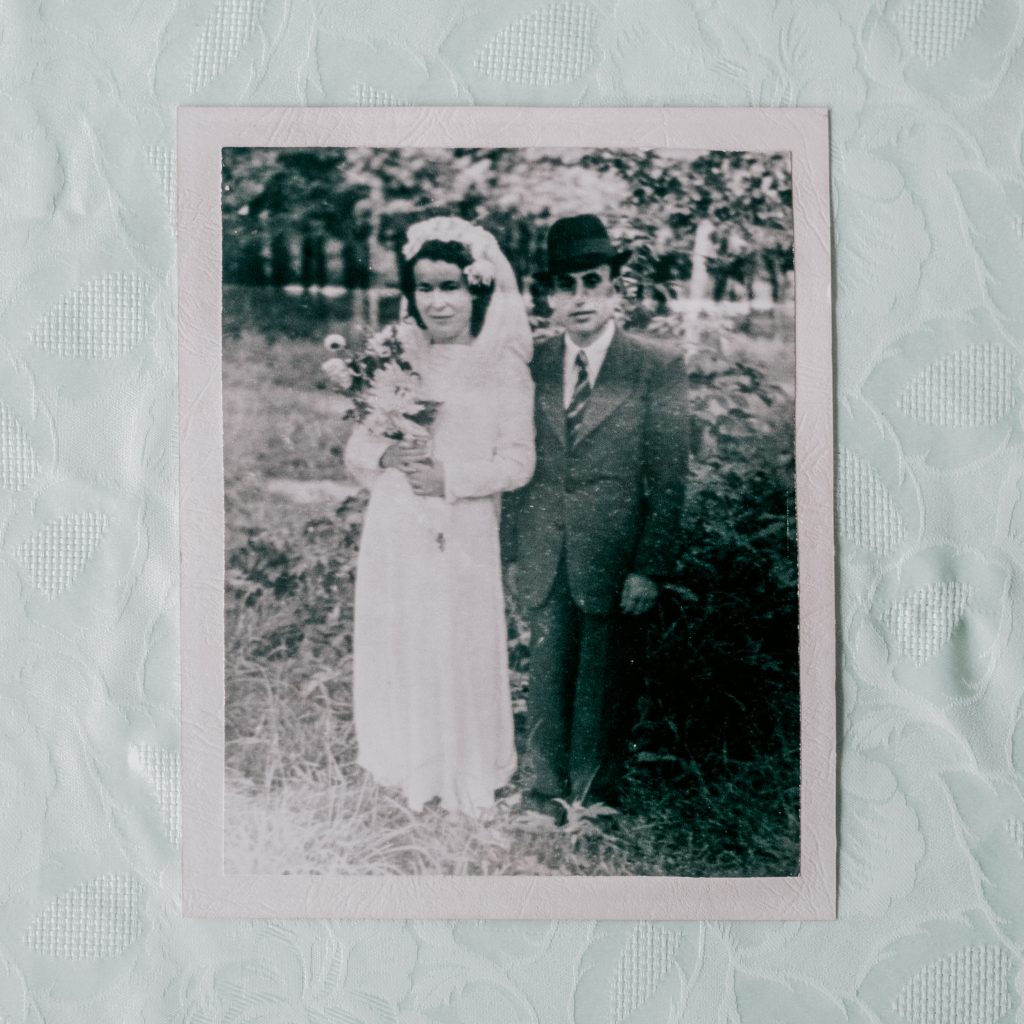
Fruma Segalyte and Avram Samson
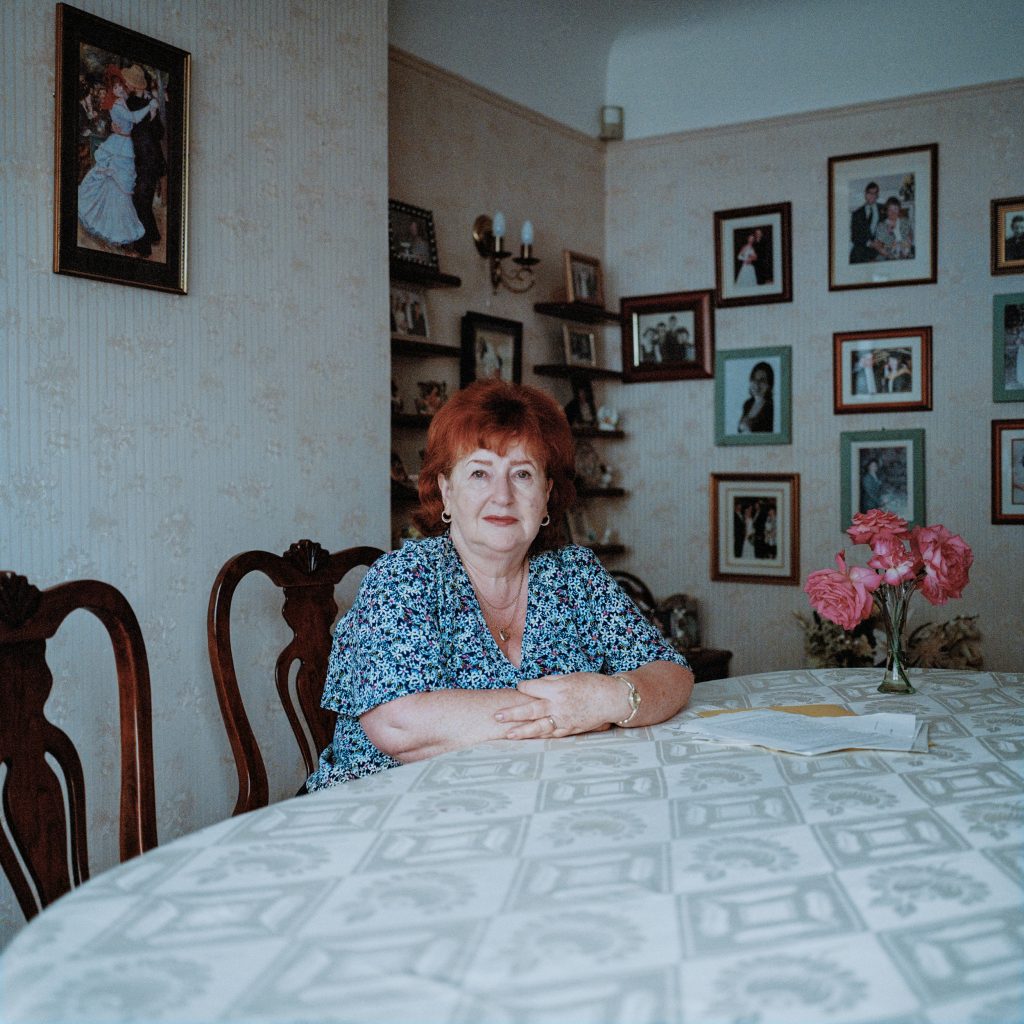
Hettie Posner, daughter of Fruma Segalyte (1913-2007) and Abraham Samson (1919-1987). London, United Kingdom. 1 June 2018.
Hettie: The old ones, they didn’t get any help, they had to get on with it themselves. I think my dad died as a result of it all, 40 years after liberation. Officially it was angina but unofficially it was stress.
The sky fell in September 1939.
I cannot imagine what it must have been like for those people. I can’t imagine what it must be like waiting for the Germans to come marching up the street to take you. He’d say, “Oh, it was two years here, one year here, it was six months here and then we went there.” What would it be like for those people working in the pits, working in mines, doing what they did?
Elvin: I would go and stay with my parents and we’d walk to Wembley Synagogue which, from where they were living, was quite a way. At that point my father had angina, he was in pain. I remember walking to the synagogue on Yom Kippur and he was stopping every few minutes putting the white tablet under his tongue.
I said, “Look, I’ll take you in the car.” He said, “No, no, no,” and I can’t remember how it came about but he did say something [about how] he never thought he would survive the war when he survived the war. He didn’t think he’d get married and then he got married. He didn’t think he would live long enough to see children and then he saw children. He didn’t he’d live long enough to see get his children married and his son and daughter –Hettie, and my brother – they were both married and he didn’t even think he’d live long enough to have grandchildren. There was a man who was aware of his mortality; who, based upon his experiences, was so battered, so bruised, and yet he was somehow saying, “Look how I’ve been blessed.”
Even on the day he died, he went to two shops to get some food in for mum. “I’m just going to have a bath,” he said, and that was the end of it. The point is, he was tremendously positive Mum was depressed all her life. She was depressed and he was so jolly and lovely.
On one occasion, he had a bandage around his thumb and he said he’d cut it. It was getting redder and redder. I said, “Let me take you to the hospital.” “No. No, I want my supper first.” He had supper, I took him and a doctor came out and said he was stitching up dad, It’s amazing. He let us do it without any anesthetic.
It took us years to find out when Mum was born, then only in the five-year period before and after she passed away – she passed away in 2007 – did we discover that she was older than she was. She claimed to have been born in 1920 or 1921 and, in fact, she was born in 1913.
The amazement to discover after she’d died that she was actually seven years older than we all thought. Also the fact that, considering what she’d been through both physically and mentally, she survived to the age of 94.
In the 1950s, there was restitution paid to victims. What was amazing was that the for compensation purposes, the Germans rated my mother to have suffered more than my father. If you consider my father: he was shot in the knee, he was stabbed in the neck, was beaten and God knows whatever else. He only survived because when he was liberated; he had typhoid and he wouldn’t have survived typhoid in the camps, but he was liberated and treated. And my mother was rated higher than that.
We would have Friday night dinner and my mum would go off to wash up. Something would spark my father and he could talk for two or three hours non-stop. I virtually said nothing because it really was an eye-opener and then he’d say, “Okay, that’s that.” I really do think it was therapeutic because he didn’t necessarily sit down and discuss it with us.
Hettie: They had no counselling. I mean today they’ve got counselling for the survivors and all sorts of things whereas there was nothing for these people. They would just get on with it.
Some of them did not talk. Some of them never spoke [about it] throughout their lives and a lot of second-generation survivors are quite screwed up. I remember going to a group once for the second generation and somebody said their father was, I think, a priest or a vicar, something like that. They only realised after his death that he was Jewish and he had been hidden as a child.
Elvin: I also think that it’s quite amazing that a lot of the second generation who, however damaged they might be, have managed to maintain a reasonable life.
You know, you’d look at them and they [look to be] your typical happily married family with a couple of kids and grandchildren, yet I would argue that virtually every child of Holocaust survivors has been damaged in some way.
To this day with my Jewish contemporaries, I don’t see them in a different way: they’re not worse than me, they’re not better than me. But somehow I feel apart from them. They cannot begin to understand what I know about my parents and what my parents actually endured and, in turn, what their siblings endured.
Hettie: There are so many stories from when mum was in Kovno. She’d been to see her brother in another town. He had seen her home on the train and kissed her goodbye and she always said she cried as if she knew she might never see him again. She couldn’t have known but it was instinct or something.
She was living with her sister in Kovno and they looked out of their window one morning and could see the airport was on fire. I suppose that was the start of it, the German bombings. They could see the smoke and the fire. There was pandemonium and the girls thought they had better run. They packed up their stuff and, mum always told us, some people said, “Come with us. We’ll give you a lift.” The girls got their things into the car, but then the family drove away with the girls’ belongings. They lost their possessions almost straight away.
They were wandering here and there with a group of other girls. They were resting in a field and Mum’s sister said they had heard there was work in the next town or village and she said to my mum, “You stay here and I will go and look to see if there is work in the next town.” Off she went and my mother never saw her again.
I’m sure all her life she regretted staying there and letting her go because nobody knows what happened to her. She had no idea and throughout her life she always searched for her missing sister. That was very traumatic.
The girls continued to walk and were stopped by a German lorry. The soldiers asked them where they were going but they didn’t know. The soldiers said, “We’ll take you into Kovno, because without us you won’t get there alive. The local Lithuanians were murdering them [the Jews). The rivers were flowing with blood.
The girls were grateful; they got into the German lorries and the soldiers actually covered them and drove them into Kovno and into the ghetto. In the ghetto there were allotments, and that is where they worked. She was there for the whole time the ghetto existed.
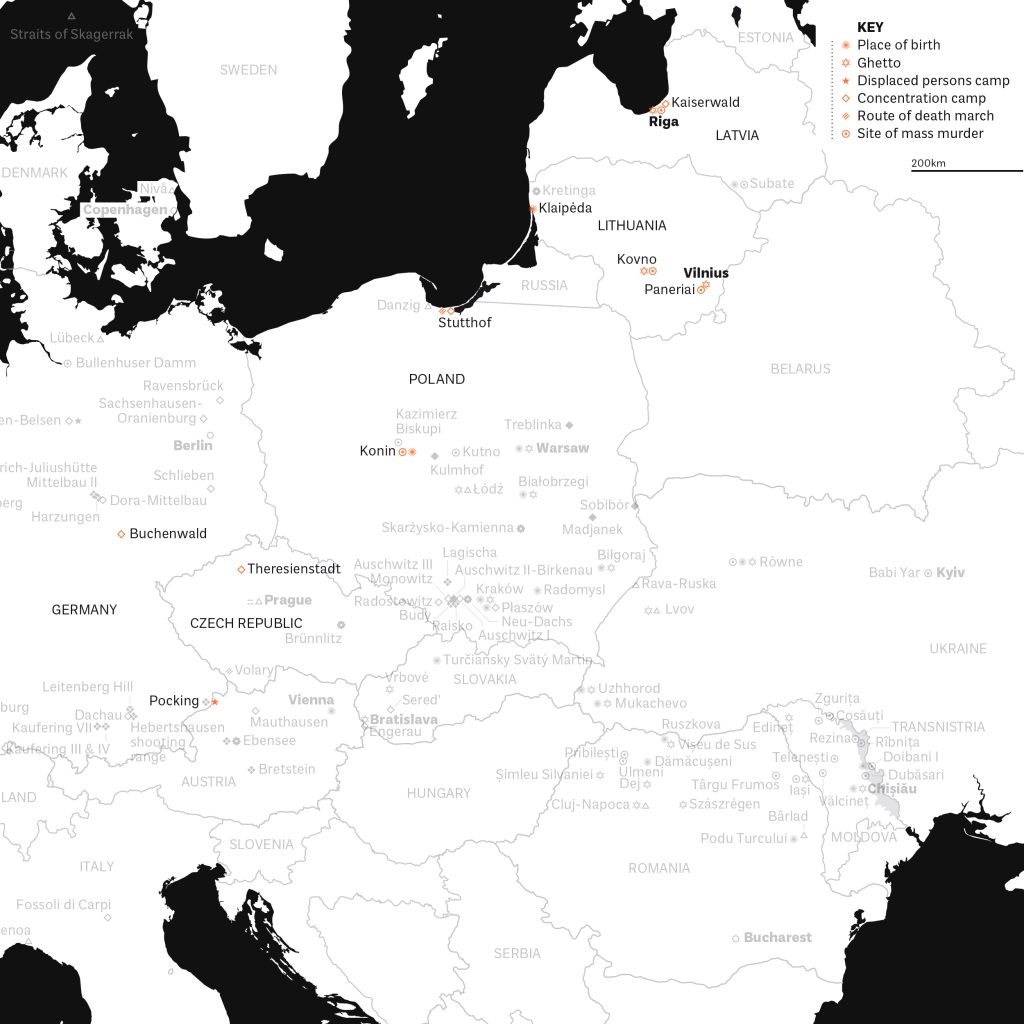
She used to talk to us about a smaller [ghetto] and a bigger [ghetto] and I later found out that was absolutely right. One of the ghettos was burned down and they went into another ghetto, all part of Kovno, and they stayed until the whole ghetto was razed to the ground. Mum went by ship – they talk about crossing the Baltic Sea – to Stutthof. We don’t really know what she did from there. We’ve never been able to find out what she did but she talked about working in the woods or a forest.
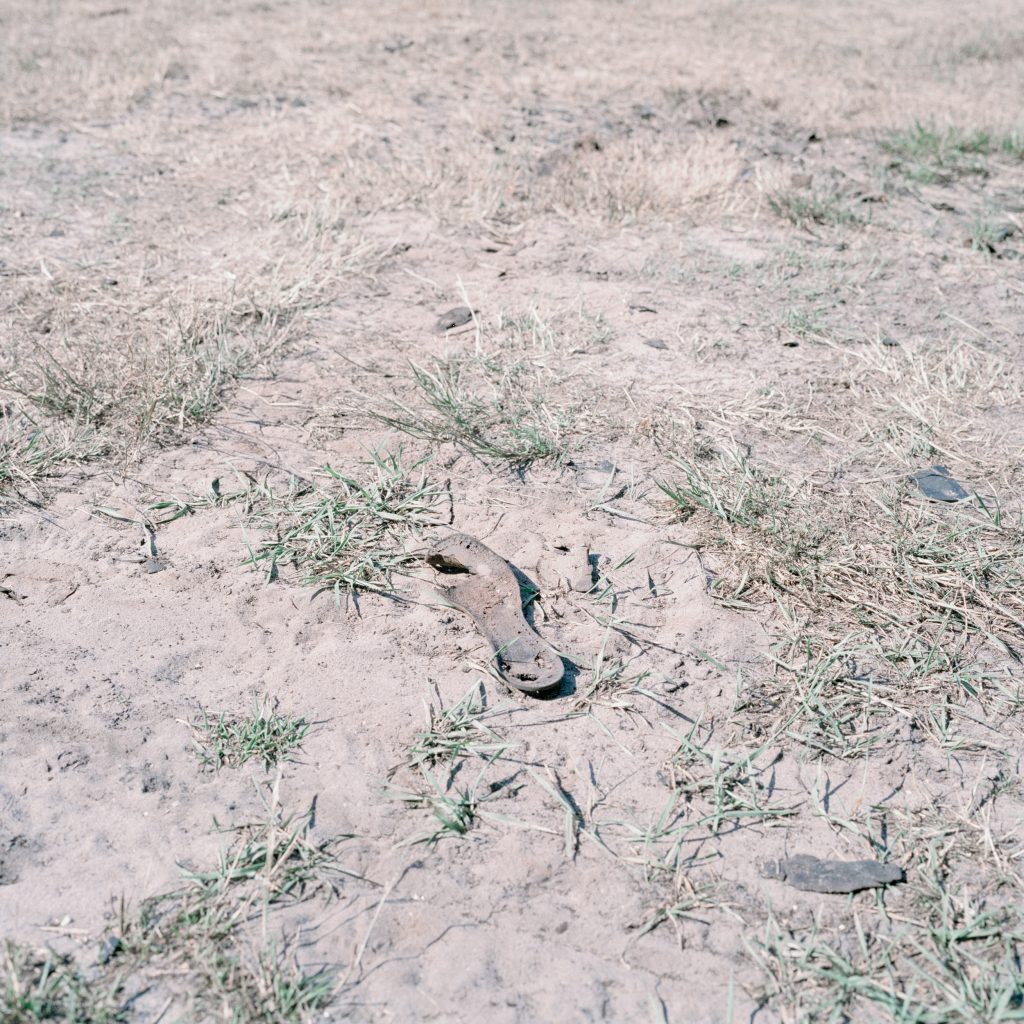
Hettie: Somewhere along the line, mum went on a death march. She walked in the snow, she talked about the wooden shoes, the clogs.
Elvin: Mum said that she was struck once by a member of the Hitler Youth and she cried and cried. She said it was the only time she cried. I they were on the march and she needed to go to the toilet so the guard said to go behind a tree.And when she came back, he thought that she had taken longer than she should have, so he hit her and said, “You know, I could kill you.” She no longer cared so she said, “Shoot me,” and again fate intervened. He walked away.
What upset her was that he was a young person and to treat somebody in that way… My mum would have been 25 or 30, but that made her cry.
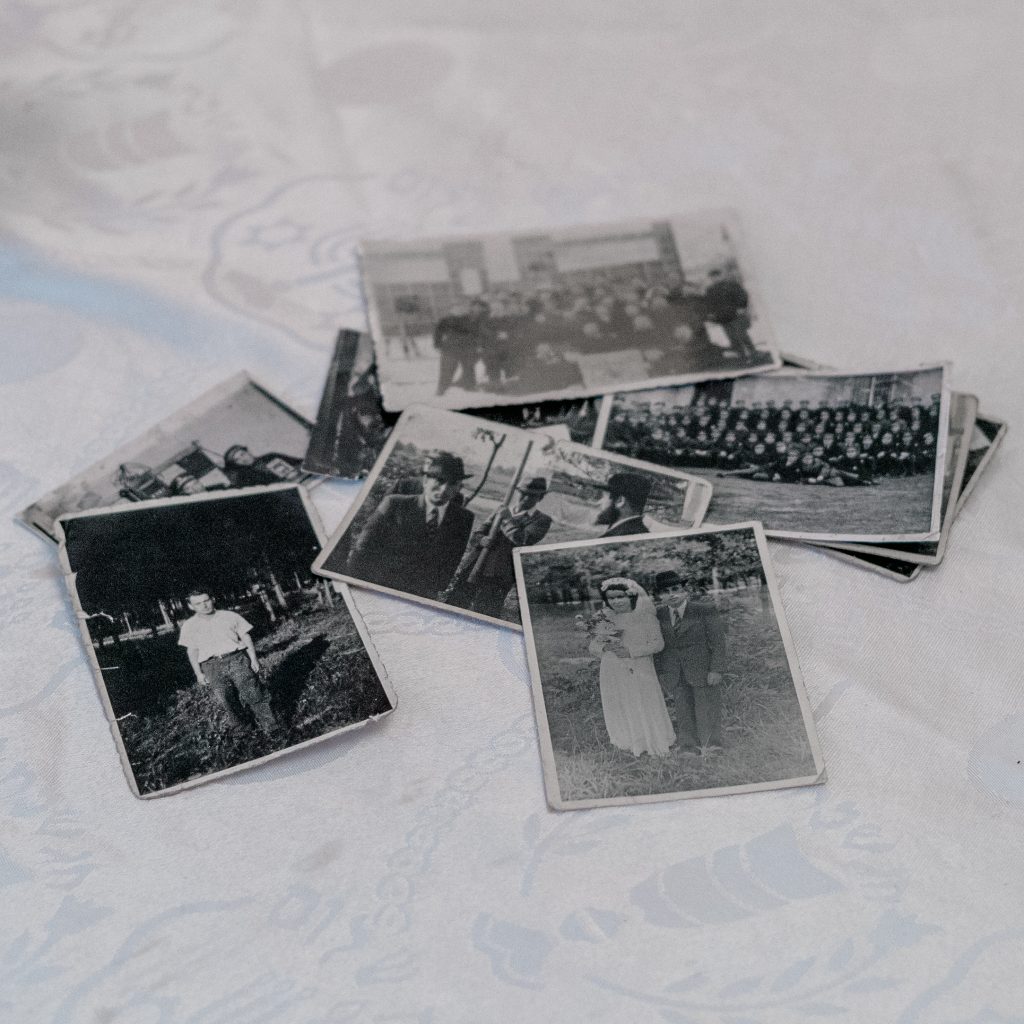
On one occasion, she was marched into a camp, it may have been at the end of one of these marches. She still had a rucksack on her back which contained one or two family photos.
They were marched into the camp and told to have a shower. Now, by this time my mum and her fellow people knew what was going on. [They thought,] we’re not going to have a shower; that’s it – we’re going to the gas chambers. Thinking she was going to die, she dug a hole in the ground and buried the rucksack in the hope that somebody would find it and get it to her family. She went into that shower, and it was a shower.
And I know she was heartbroken. When she came out – and I don’t know what length of time it was by the time they stripped off and whatever and came back – the rucksack was gone. Those were the only mementos she had.
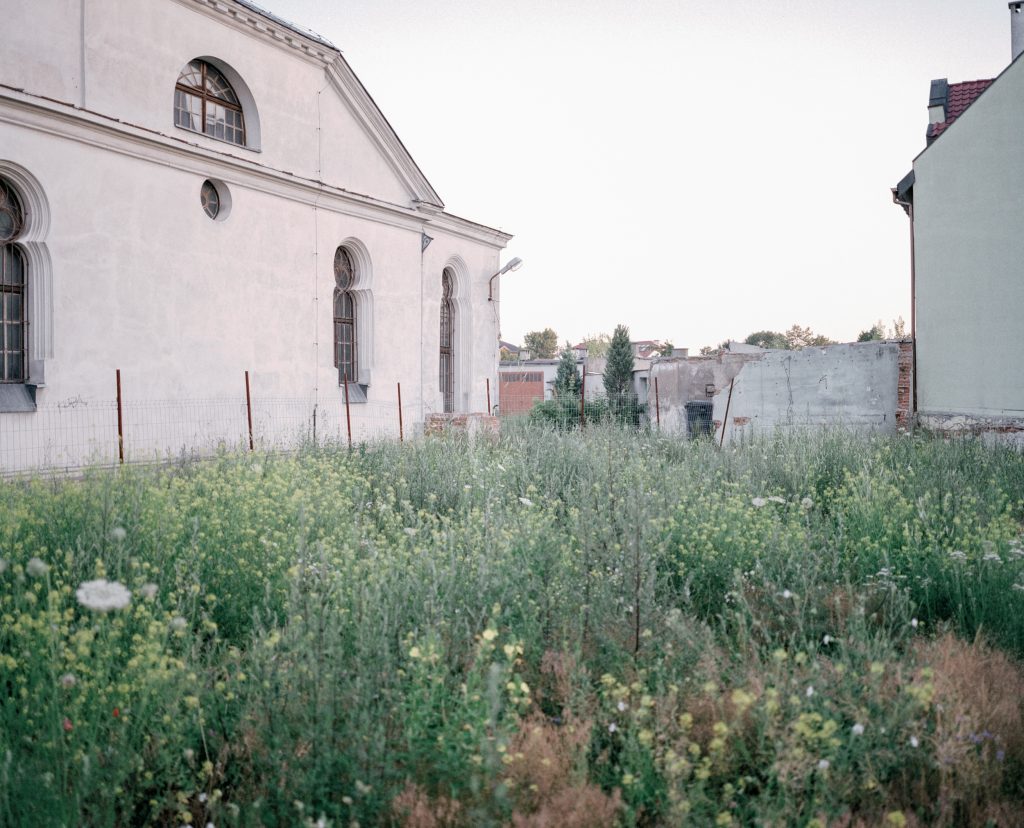
Hettie: Dad’s story was different. He was living in Konin, Poland, when the Nazis came in. His dad’s mum and his dad’s father and possibly sister were all in the synagogue. They were all killed right away. My dad made suitcases for a living, the big tin things that they had in those days. I think he said that at first he was forced to make them for the Germans, the Nazis. He witnessed in the beginning, hangings, all sorts of horrible things going on and, I suppose, eventually in the camps. He worked in the quarries for about a year and then went from one camp to another. He was in Buchenwald. My dad was whipped; one time they were stealing chickens, or eggs or something and I think he was strung up and whipped.
Dad was liberated from Theresienstadt on 8 May 1945. He had survived by being arrested at the beginning of it all.
They both ended up in this displaced persons camp in Pocking in Germany, and they met each other. Mum always said he was gorgeous; my dad was absolutely gorgeous.
My mum always said people were hungry not just for food, but for love and companionship.
He was from Poland and she was from Lithuania and they spoke Yiddish to each other. They married very quickly and our brother was born there in the camp. I think Dad did go back to Poland to see if there was anything there. He made his way back there on his own and was welcomed. There was nothing there for him, of course. He was welcomed back by the mayor who wanted him to go into the Polish Army but there was no way on earth he was going [to do that] and I think he had to sneak out and make his way back to the camp.
— Told by Hettie Posner and Elvin Samson, daughter and son of Fruma and Avram